Dear Ms. Brann
Plato names four virtues in the Republic — wisdom, courage, moderation, justice — and if I am honest about which of them I have been weakest in, it is moderation. Not for lack of knowing better. I wrote to you last time about drinking less, exercising daily, keeping a diary, spending more wisely. That list has not changed much over the years, which is rather the point.
So I went back to Book IV this week to see what he actually says. The passage that caught me was about the phrase “master of himself.” Socrates finds it ridiculous at first — if a man is his own master, he is also his own servant, and the same person is being described both ways. Then he resolves it:
“In the human soul there is a better and also a worse principle; and when the better has the worse under control, then a man is said to be master of himself; and this is a term of praise: but when, owing to evil education or association, the better principle, which is also the smaller, is overwhelmed by the greater mass of the worse — in this case he is blamed and is called the slave of self.”
What struck me was that the better part is also “the smaller.” Reason is outnumbered. And moderation, for him, is not reason beating desire into submission but a harmony — the parts of the soul “equally agreed that reason ought to rule.” Not the absence of desire. An agreement about who rules.
That is close to how I have come to think of it: choosing what not to do. Desire arises the way hunger arises when it is time — I cannot do much about its arrival. What I can decide is how to respond, and who gets to answer. And that begins, I think, with priorities: across the whole of life, what comes first and what comes after. But I will be honest. The problem has never really been that I failed to set priorities, or never thought about them. The problem is the distance between a priority and a habit — the daily, unglamorous work of letting the priority actually steer the day. That is what I find hardest.
Where it shows most is in two places: time and money. Where I spend my hours and where I spend my money — nothing reveals the trajectory of a life more nakedly than those two ledgers. So beyond the workstation I have been building at work, I have been building tools for my own finances and my own time as well. Not because a tool makes a man moderate, but because looking at myself every day is a habit I want, and a tool makes the looking easier.
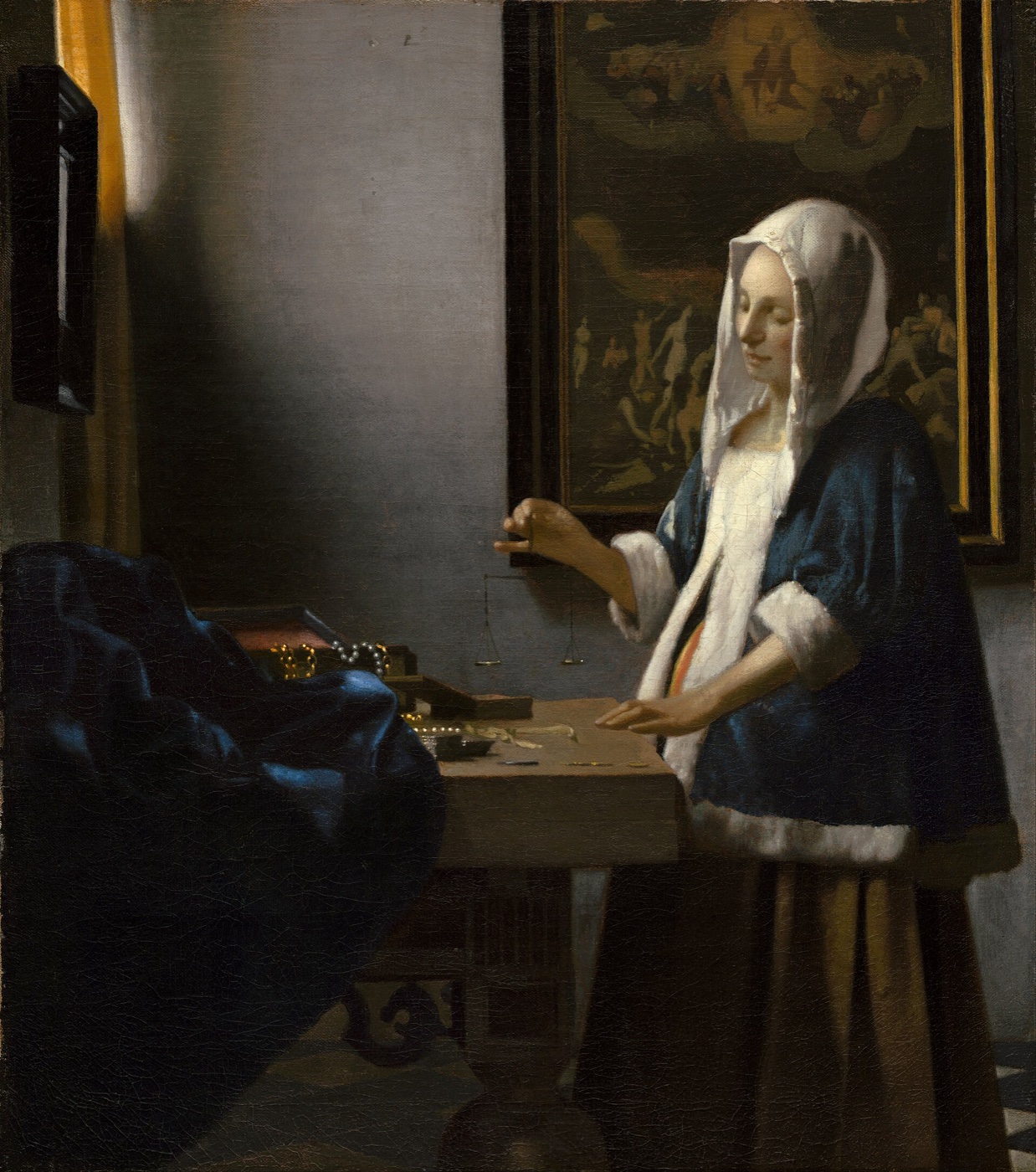
Johannes Vermeer, Woman Holding a Balance (ca. 1664)
Plato’s temperate man, after all, is not an ascetic; he indulges his appetites “neither too much nor too little, but just enough.” He has found the amount. I suspect you find the amount by measuring.
The other thing I have been admitting lately is that I am weak — and with that, how much the environment matters. I used to believe that habits, like results, had to be forced through by the individual’s own will. These days I notice that where I put myself decides, more than I would like, whether I become what I want to become. As small as how clean my room is. As large as who I am working with, and how much of that I can actually feel in a given day. Habits spiral. One good one pulls in another; one bad one — a cigarette, a drink, a wandering want — invites its neighbor. Socrates says the soul, once its parts are bound together, “is no longer many, but has become one,” and only then “proceeds to act.” I read that less as a portrait of a finished man and more as a direction: each better day makes the next one slightly more likely.
So this is the letter in which I tell you that the work now looks smaller than I used to imagine it. One cleaner room. One written page. One drink not taken. Not a leap, but a spiral — and a prayer that it turns the right way.
Agwn